Parachute Experiment
Ella and Brisa
Physics
QSI International School of Papa
27 October 2023
Abstract
We completed an experiment to determine what effect the weight of an object has on how fast it will fall when attached to a parachute. This is important because it proves Newton’s second Law that net force equals mass times acceleration. This also portrays how air resistance and gravity work on free-falling objects near Earth’s surface. Our hypothesis was that if the object attached to the parachute is lighter, then it will fall slower, and if the object is heavier the object will fall faster, which we later proved was correct. We did this experiment by building our own parachute and measuring the time it took for different objects with different masses to reach the ground when dropped from a window. By doing this we learned that the lighter mass an object has, the slower it will fall to the ground because the parachute will slow it down the most. Heavier objects pull with more force and therefore will accelerate faster to the ground.
Introduction
For this lab report, we are experimenting with the weight of an object attached to a parachute to determine if the weight of the person using the parachute affects how fast they fall. We’re completing this experiment because it is a requirement to complete a unit for our Physics class. The information we will collect is useful for us to collect because it will help prove Newton’s first law and will be a good demonstration to draw force diagrams for. If the object attached to the parachute is lighter, then it will fall slower, and if the object is heavier the object will fall faster. The manipulated variable in this experiment is the weight of the object. The responding variable is the time that the parachute takes to fall to the ground. Some of the constants in this experiment are the height that the parachute is dropped from, the parachute the objects will be attached to, who the parachute will be dropped by, and (hopefully) the day that the objects will be dropped.
Materials
- Plastic bag
- Scissors
- Thin string
- 3 objects with different masses (We used an empty spool, a wooden block, and a fishing weight)
- Ruler
- Tape Measure (Long)
- Scale
- Stopwatch
- Rope
Procedures
Safety: Make sure the area you are in is clear before dropping the parachute. Observe caution when using scissors or any other sharp objects.
- Find a plastic bag and cut off the top in a straight line below where the handles are like the picture below.
- Cut the bottom in a straight line so both sides of the plastic bag are open.
- Open the bag and cut one of the long sides open so you can unfold the plastic bag.
- Fold the top right corner towards the bottom of the bag to create a right triangle.
- Cut out this triangle and then fold it in half to create another right triangle.
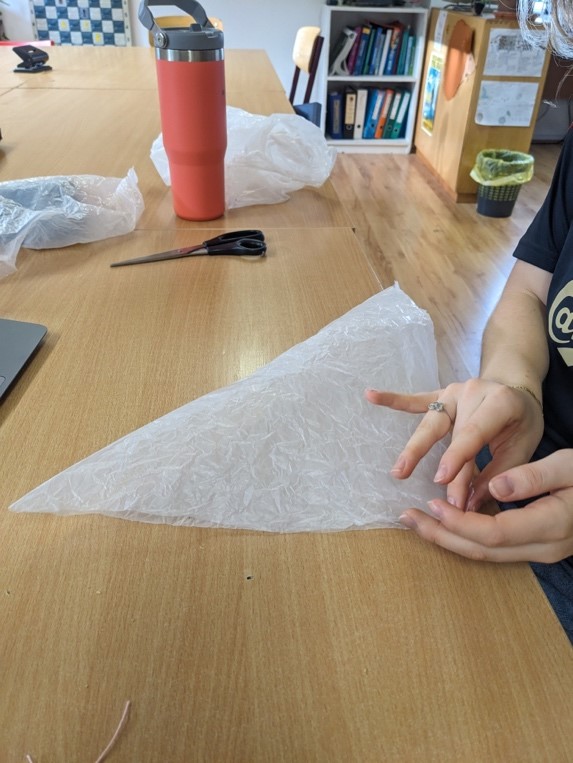
- Fold it in half again to make another triangle.
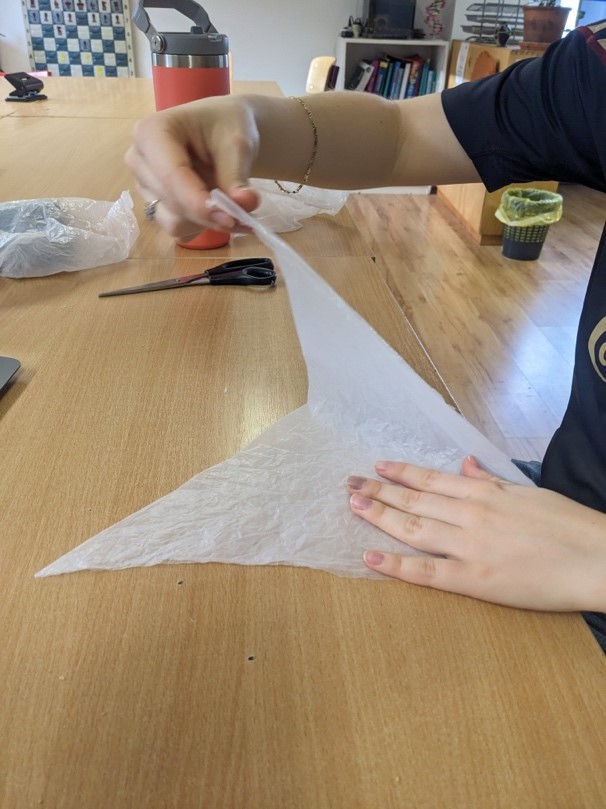
- Fold the shortest side over to the longest side so that there is a tip of the triangle sticking out.
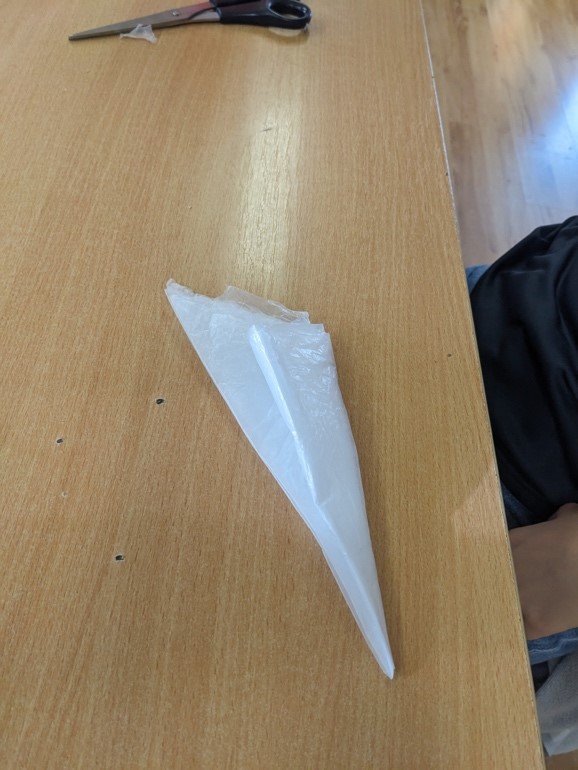
- Cut off the tip sticking out in a slightly curved line.
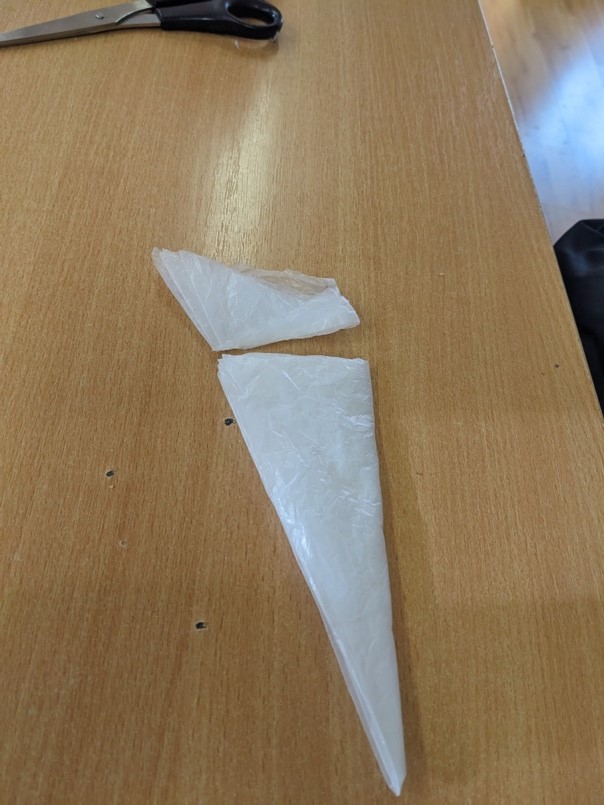
- Fold it in half again and cut a little triangle shape out of the side that is folded.

- Unfold the triangle so that it makes a circle.
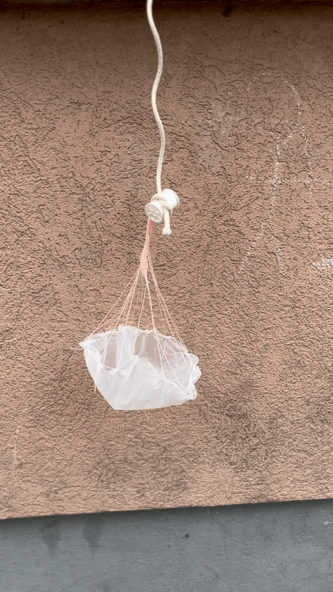
- Cut out 16 pieces of string that are each 2 feet long (60 cm).
- Tie the end of a string around each of the holes in the circle.
- Connect all of the strings at the end and leave some string to be attached to the three objects of different weights.
- Place each of the three objects on a scale to find out how much they weigh in grams.
- Measure the distance from the ground of the place you will be dropping the parachute from using a long tape measure, or if it is too short, a rope.
- Record the height that you measured or use a meter stick to find out the length of the rope used.
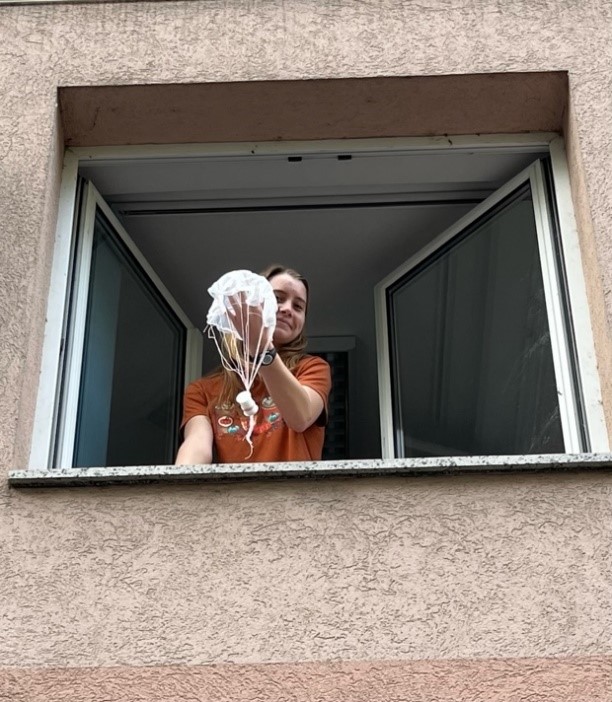
- Attach the first object to the parachute and drop it from the height already predetermined.
- Record the time it takes for the parachute to hit the ground. Redo the trial if the parachute runs into anything it shouldn’t or if there is an outside factor that affects the fall.
- Use a rope to retrieve the parachute after each drop.
- Repeat steps 17, 18 and 19 until you have done 5 successful trials and then do the same thing with the other two objects
Data and Results
Drop height – 4,18 m
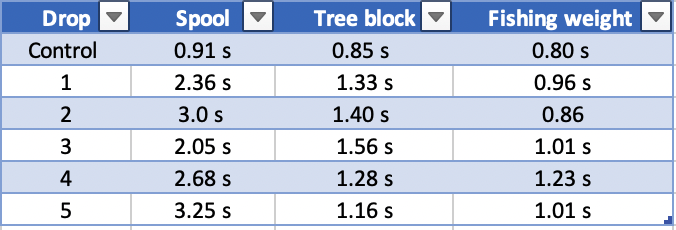
Averages – Spool: 2.7 s
Tree Block: 1.35 s
Fishing Weight: 1.01 s
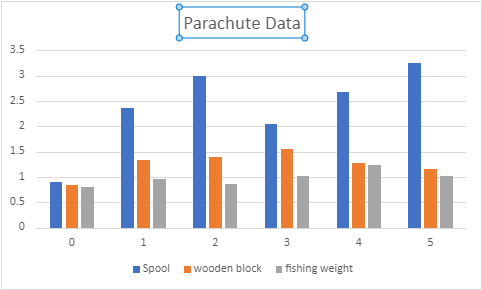
The parachute was most effective on the spool, since it had the lightest mass and least effective on the fishing weight, since it had the heaviest mass. Our results are illustrated in the graph above. Drop 0 was the control trial where the object was dropped by itself so that we could show how much the parachute affects the speed of the fall. Without the parachute, all three of the objects were falling at the same acceleration of –9.81 m/s2 so we only had to do the control trial once. From the graph, it is clear that the parachute had the greatest effect on the spool because the trials done with the parachute were much slower than when the spool was dropped by itself (Slowed it down by 296%). The parachute had the smallest effect on the fishing weight because the times for the trials with the parachute versus without are very similar (Slowed it down by 126%).
Conclusion
Our hypothesis was correct because the heavier the object was that we dropped, the less time it took to hit the ground. This is also shown by our control trials for each of the different objects since the time for the spool (0.91 s) was greatest and the time for the fishing weight (0.80 s) was the least. The parachute helped slow all of the objects down, but it worked the best on the spool. This is probably since it’s the lightest and the parachute is strong enough to slow it down a large amount. With the fishing weight, which was quite heavy, the parachute helped to slow it down a little bit, but we think if we had had a bigger and stronger parachute, it would have worked better. This study shows that air resistance is a type of friction because when we used a parachute, which increases the surface area of the object being dropped, the object takes a longer time to fall meaning it was subjected to more air resistance. This also helps prove Newton’s Second Law that net force equals mass times acceleration. The acceleration of all of these objects should be –9.81 m/s2, so the mass is normally the only thing that should change the net force acting on the objects. However, with the parachute the air resistance is greater, and this effect is shown best by the lightest object. This is exactly what happened because the greater the mass of the object that we dropped, the faster the object fell, or the greater the force acting on the object. These conclusions can be used in everyday life because when parachutes are made, the producers have to take into account the weight of the people that are going to be using them. They can determine the force that the person will experience while falling if they know the mass of the person and the amount of air resistance of the parachute. Some further questions that would be very interesting to investigate are how the shape of the parachute affects the speed of the object falling and how heavy winds affect the path and performance of a parachute.
Bibliography
Experiment Army. “How to Make a Parachute at Home from Plastic Bag.” YouTube, YouTube Video, 12 July 2019, http://www.youtube.com/watch?v=uA_qzmaDF_8. Accessed 3 Nov. 2023.
 QSI Pápa News